Why Appointment-Based Deliveries Are the Future of Quick Commerce

Serviceability, tracking, EDD, NDR, manifestation, documented and live.

No tangle of line items. Pick the model that fits how you work across storage, order processing, shipping and technology.

Ship Smarter. Grow Faster.
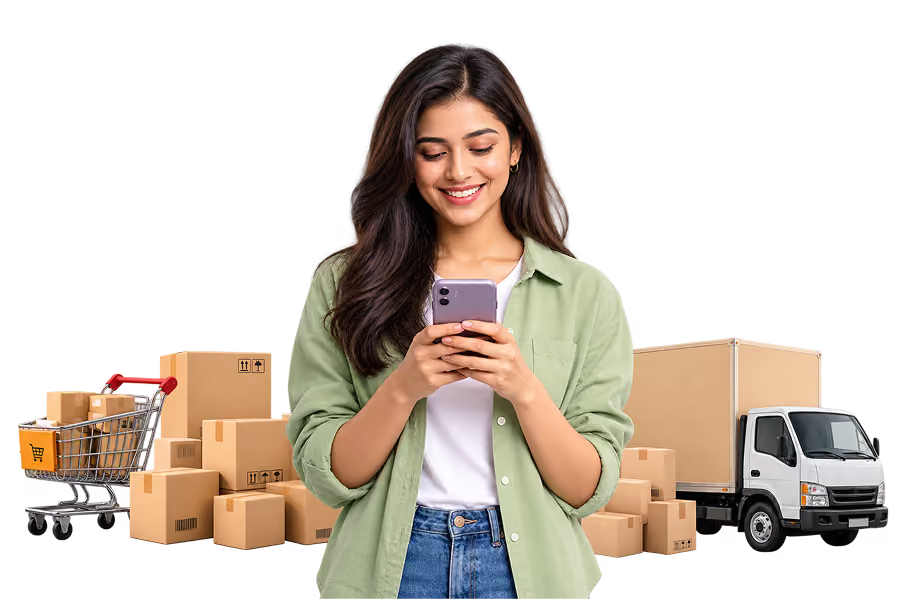
Today, it is not only about whether you can provide quality products to your customers or not. With digitalisation on the rise, online ordering has become a part of daily routine rather than a luxury. Now the consumers’ expectations are rising, and they want their deliveries to arrive as fast as possible.
But behind a successful delivery is a strong fulfilment strategy that ensures your orders aren’t delayed, and the customers aren’t disappointed. That’s why today’s eCommerce platforms are promising “same-day” or “next-day” deliveries so they don’t lose to competitors.
To establish a strong logistics channel, you first must understand eCommerce fulfilment models and how they support your company’s growth.
Contents
An eCommerce fulfilment model is the strategy adopted by businesses to complete their orders, right from packaging to delivery.
Earlier, there was just one, i.e., the self-fulfilment model, where brands were responsible for the entire logistics chain. But with the increase in customer demand and competition in the market, companies are rapidly adopting 3PL and dropshipping so they can focus on core tasks.
As a business strategist, you know that every step plays an imperative role in successfully delivering the order. That’s why you must choose the fulfilment model carefully based on your budget and monthly order volume. But how? Let’s understand it better.

Here are the five kinds of fulfilment models majorly ruling the eCommerce ecosystem, giving you the choice to streamline your operations your way:
The in-house process is where you carry out the entire process, from start to end. There is no involvement of a third party, and you have to ensure that the orders reach customers on time.
This model is opted for by companies that have a small startup with low order volume. For example, Instagram and Facebook sellers receive, pack, label, and ship all the orders themselves.
The 3PL model is where you ship your products to a third-party fulfilment centre and shift the entire responsibility of successful deliveries. You don’t have to worry about the warehouse or the time-crunching deliveries.
The model is adopted by companies when their order volume becomes high enough that they find it difficult to manage. Any concerns regarding failed or delayed deliveries are handled by the 3PL service providers. All you have to do is send the stock to their warehouse on time.
In the dropshipping model, you neither have to manufacture nor ship the products. All you have to do is list the products online and enjoy the profits after order fulfilment. The manufacturer handles the entire process, while you have zero control over the logistics.
When brands like yours adopt the dropshipping model, customer satisfaction depends on how the dropshipper handles the process. Your control and involvement are restricted.
FBA (Fulfilment by Amazon) is a specialised third-party logistics model where you can directly send your products to the Amazon warehouse. In this situation, Amazon handles the entire logistics process, and your responsibility is to send products that are low in stock to the fulfilment centre.
POD is a form of dropshipping for printable products. Brands print T-shirts, caps, merchandise, and books when customers place an order. It helps ensure that no product goes to waste.
Although FBA and POD are also prevalent fulfilment model approaches, they aren’t as common as the other three. Below is a quick comparison of in-house, 3PL, and dropshipping so you can understand their use cases:
It is important that you assess your business requirements before finalising the eCommerce fulfilment model. It is a strategic move which can make or break how customers see your brand in the long run. Here are the main factors to consider when selecting the model for your logistical operations:
You can easily handle a low volume of orders and don’t need to appoint fulfilment centres to take care of your tasks.
When your orders continuously increase and become too much to handle, you can shift to a 3PL service provider who takes care of the operations.
You must establish a strong fulfilment model if customers expect same-day or next-day delivery. If you can’t assure quick order fulfilments, then 3PL is the right model to invest in.
With increasing competition, you must retain customers by being technologically sound. 3PL service providers offer a real-time tracking facility so your customers are always aware of their orders. They also offer inventory management services, so there’s no under- or overstocking issue.
If you are only trying out a low-risk startup, then dropshipping is an appropriate route. However, choose 3PL services if you plan to grow your business and bring in more orders without struggling with operational complexities.
Analysing the cost structure is important before you finalise an eCommerce fulfilment model. It helps determine if your company is ready to take up the expenses or not.
Here are the major cost inclusions that you must consider:
The transportation cost from the warehouse/fulfilment centre to the customer’s doorstep.
The cost involved with storing your products in a 3PL warehouse. It depends on the storage duration and volume of products.
Material and labour costs cannot be ignored. These expenses ensure that the orders reach customers in good condition.
The cost involved with orders returning to the warehouse and restocking them on the shelves.
Several brands begin with an in-house fulfilment model for complete control and to avoid the stocking fees. However, it is important to switch from self-fulfilment to a third-party logistics model when:
Growth means increasing orders, and that means a warehouse where you can store, pack, and ship products without delay. That’s why companies generally choose a 3PL fulfilment model where they don’t have to deal with logistical constraints or high warehousing rent. Here is how it helps your business to optimise the fulfilment model:
Unlike companies with one-stop warehouses, fulfilment centres have multiple delivery touchpoints that reduce the travel distance. As a result, the shipping cost reduces, and you can optimise your deliveries in every city.
You no longer have to focus on picking, packing, and shipping the products and can handle strategic tasks. Fulfilment centres take care of the logistical operations on your behalf and leverage tech-driven software for automated tracking and inventory management.
Fulfilment centres focus on delivering orders to your customers speedily, increasing customer satisfaction. They also offer live tracking and smooth return processing, so customers trust your brand more.
Order fulfilment seems easy, right? However, the real problems begin after the first sale, and that’s where the brands struggle. Here are the major challenges that companies struggle with and how they can overcome them:
Although a high order volume means increasing profits, it also means major pressure to dispatch packages on time. Every order has a designated delivery timeline, and if there are too many orders to handle, how do you handle them alone?
You can take up this challenge as an opportunity to grow. Partner with a reputed third-party logistics provider that is capable of handling huge volumes of orders simultaneously.
Online orders frequently lead to returns due to quality mismatch, wrong sizes, or a simple “change of mind”. But if you don’t have a proper exchange and return process in place, chances are that customers won’t return for the next purchase.
Your return process should be seamless and quick for customers so they don’t hesitate to stay loyal to you. A fine example is H&M India, where customers can easily place a return order without justifying their reason.
Prolonged deliveries mean your customers have to wait longer than they signed up for. As a result, they are often disappointed and lose confidence in your brand.
However, 3PL service providers offer multiple touchpoints so your customers can receive products within the provided time frame. Quick commerce dark stores operate similarly. Customers can receive orders within 30 minutes because the stores are available at every location.
If your customers can’t track their orders, they are always in anticipation of when they will receive the package. Additionally, fleet managers also do not understand if their orders are moving at the desired speed.
3PL service providers offer real-time tracking so customers can ensure they are at the delivery location to receive the parcel. Additionally, stakeholders can ensure that the orders are executed smoothly.
Choosing the right eCommerce fulfilment model is crucial as it ensures that your business runs smoothly and the customers are happy. Self-fulfilment is suitable when the business is just getting started or the order volumes are still low. However, partnering with a third-party logistics service company is better when your order volumes are consistently increasing. It is also beneficial when you don’t want to invest in fixed warehouse expenses or can’t open multiple touchpoints for quick deliveries. Dropshipping is the best choice when you are seeking minimal control and only testing how a startup works.
Ship Smarter. Grow Faster.